
 202-301-8861
Neck Lift Washington DC
A neck lift is a surgical procedure that tightens loose neck skin, repairs separated platysma muscle bands, and removes excess submental fat to restore a defined jawline and neckline. For neck lift Washington DC patients, Dr. Jonathan Cabin builds each plan around your anatomy, skin quality, and personal goals rather than a single fixed technique.
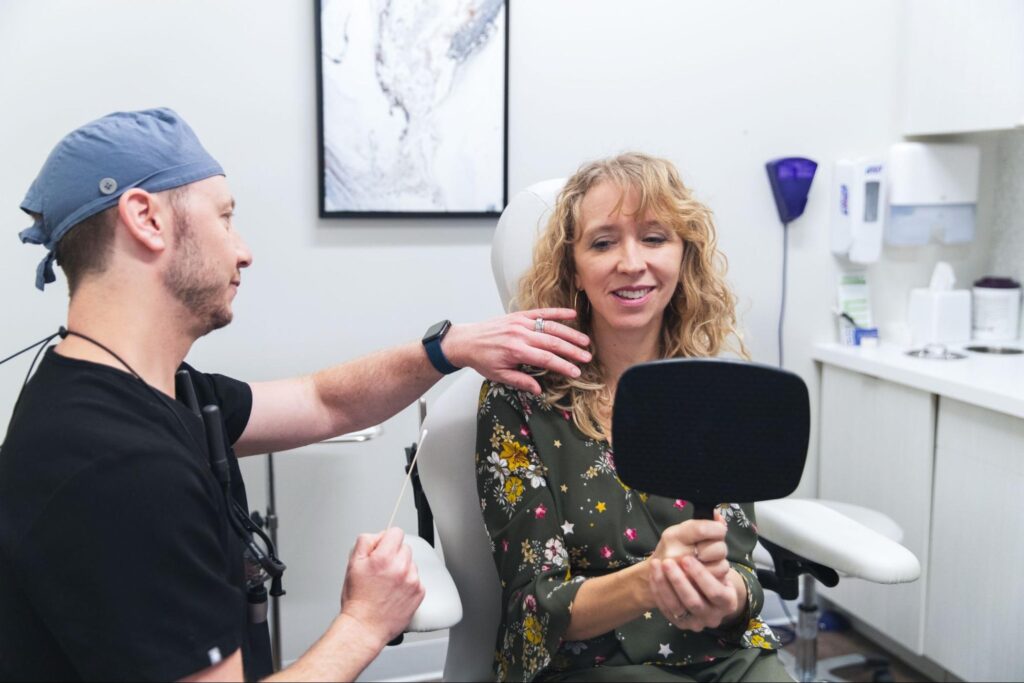
What Is a Neck Lift?
A neck lift is a surgical procedure that tightens loose skin below the jawline, repairs separated platysma muscle bands, and removes excess fat beneath the chin to restore a defined neckline and a crisp cervicomental angle. Performed under IV sedation or general anesthesia, it takes two to three hours, with roughly two weeks of social downtime for most patients.
The neck ages in layers. Skin loosens, the platysma muscle separates into visible vertical bands, and fat settles beneath the chin. A neck lift addresses those layers together, which is why it produces changes that creams, devices, and injectables generally can't match.
There are several distinct techniques, and they are often combined:
- Platysmaplasty: The paired platysma muscles are tightened and, when needed, sutured together in the midline to erase vertical banding and rebuild support beneath the skin.
- Skin tightening and redraping: Loose skin is lifted and repositioned through incisions behind the ears, then trimmed conservatively so the neckline looks smooth rather than pulled.
- Submental liposuction: Stubborn fat under the chin is sculpted through a small incision, sometimes as a standalone procedure for younger patients with good skin elasticity.
Neck Lift vs. Facelift vs. Lower Facelift
A neck lift treats the area from the jawline down. A traditional facelift addresses the midface, jowls, and cheeks. A lower facelift focuses on the jawline and jowls specifically. Because the face and neck age as one connected unit, Dr. Cabin frequently recommends combining a neck lift with a lower facelift so the jawline and neck match. Treating one without the other can leave an obvious transition.
What a Neck Lift Corrects
- Submental fullness, sometimes described as a double chin
- Vertical platysmal bands, often called "cords" or turkey neck
- Jowling that blurs the jawline
- A loss of the cervicomental angle, the crisp corner where the chin meets the neck
At CabinMD Facial Plastics & Aesthetics in Washington, DC, the neck lift is performed as a facial-specialty procedure. Dr. Cabin's training and daily practice center on the face, head, and neck, which matters when the operative field sits inches from the marginal mandibular nerve, the jugular veins, and the salivary glands.
One honest expectation to set from the start: a neck lift turns back visible aging, but it doesn't stop the clock. Your tissues will continue to age naturally. Most patients find the improvement holds for many years, and the neck typically continues to look better than it would have without treatment.
Benefits of Neck Lift Surgery
Patients pursue a neck lift for one main reason: the neck stopped matching how they feel and how the rest of their face looks. The benefits are both structural and practical.
- A sharper, more defined jawline. Tightening the platysma and removing submental fat restores the cervicomental angle, which is the single feature most associated with a youthful profile.
- Vertical bands are addressed at their source. Once the platysma is repaired, the cords that show when you speak, swallow, or turn your head are corrected structurally rather than temporarily softened.
- Resistant submental fat finally responds. Fat under the chin often has little to do with body weight. Many patients arrive fit, active, and frustrated that diet and exercise never touched this area.
- Collars and necklaces sit the way they used to. Shirt collars, ties, and jewelry fall differently when the neck is contoured. Patients notice this within weeks.
- Improved presence on camera. Overhead lighting and downward camera angles are unforgiving to the neck. In a city built on hearings, panels, depositions, and video calls, this is a practical concern, not a vain one.
- Longevity measured in years. Injectables and energy-based devices produce gradual, temporary softening. Surgical correction addresses muscle and skin directly, and the improvement lasts far longer.
- You feel like yourself again. Patients often describe the moment their reflection finally matches their energy.
Dr. Cabin's aim is a neck that looks rested and natural, never operated on. That's the heart of his advanced yet conservative approach.
The Neck Lift Procedure: What to Expect
A neck lift takes two to three hours and is performed under IV sedation or general anesthesia at an accredited surgical facility. Incisions are hidden under the chin and behind the ears. Dr. Cabin tightens the platysma, sculpts submental fat, and redrapes the skin. Most patients return to social activities around two weeks.
Step 1: Consultation and Surgical Planning
Your first visit at CabinMD Facial Plastics & Aesthetics begins with conversation, not a sales pitch. Dr. Cabin examines skin elasticity, muscle banding, fat distribution, chin projection, and salivary gland position, then reviews photography and imaging with you. He'll explain which technique fits your anatomy and, just as importantly, which ones don't.
Step 2: Anesthesia, Facility, and Incision Placement
Depending on the extent of your procedure and any combined treatments, you'll receive IV sedation or general anesthesia, administered by a licensed anesthesia provider in an accredited operating facility. Both options are discussed in detail beforehand so you know what to expect on the day. Incisions are placed where they conceal well: a small incision in the natural crease under the chin, and incisions that follow the contour behind and around the ears. Careful placement, meticulous closure, and layered support beneath the skin all contribute to scars that settle into the surrounding anatomy over time.
Step 3: Muscle Tightening, Fat Sculpting, and Skin Redraping
Technique matters most at this stage. Dr. Cabin releases and repositions the platysma, addresses subplatysmal fat when it's contributing to fullness, contours superficial fat, then redrapes the skin without tension. Skin should follow the deeper repair, never carry it. Over-tightened skin produces the pulled look most patients want to avoid.
Step 4: Recovery Timeline
| Time Frame | What to Expect |
|---|---|
| Days 1 to 3 | Compression garment worn nearly full time. Swelling and tightness peak. Rest with your head elevated. Discomfort rather than pain for most patients. |
| Days 4 to 7 | Swelling begins to settle. Light walking encouraged. Sutures come out around day 7. |
| Week 2 | Most patients feel comfortable returning to desk work and low-key social plans. Bruising can be covered with makeup. |
| Weeks 3 to 6 | Progressive return to exercise. Numbness and firmness under the chin gradually resolve. |
| Months 3 to 6 | Residual swelling resolves and the final contour settles into place. |
Recovery varies with your anatomy, whether procedures were combined, and how closely you follow post-operative instructions.
Combining Procedures
A neck lift is frequently paired with a lower facelift, chin augmentation, or eyelid surgery. Combining is often the more efficient choice: one anesthesia, one downtime and recovery period, and a result where every feature is in balance. A weak chin can make even a well-executed neck lift look incomplete, which is why chin projection is always evaluated during your consultation.
Are You a Candidate for a Neck Lift?
Good candidates have loose neck skin, visible platysmal bands, or submental fullness that no longer responds to nonsurgical treatment. Most are between 40 and 70, in good general health, and hold realistic expectations. Younger patients with genetically heavy submental fat and strong skin elasticity may be better served by liposuction alone.
You may be a strong candidate if you recognize yourself in several of these:
- Skin along the jawline and neck has lost its snap
- Vertical cords appear when you speak or look in the mirror
- Fullness under the chin persists despite stable weight and regular exercise
- Your neck reads older than your face
- You're a non-smoker, or willing to stop well before and after your procedure
- Your weight has been stable and you're not planning significant loss
When Nonsurgical Options Make More Sense
Dr. Cabin will tell you plainly if you're not ready for surgery. Helping you discover your best self is at the center of his practice, so you can trust that he will only recommend treatment if he feels you'll greatly and immediately benefit. Depending on what your exam shows, better first steps might include:
- Deoxycholic acid injections for isolated submental fat with good skin quality
- Radiofrequency or energy-based skin tightening for mild early laxity
- Neuromodulator injections to soften prominent platysmal bands in select patients
Here's how the two paths compare across the concerns patients raise most often:
| Concern | Nonsurgical Option | Neck Lift |
|---|---|---|
| Mild submental fat, good skin tone | Often appropriate | Usually not needed yet |
| Loose, inelastic skin | Limited benefit | Directly addressed |
| Visible platysmal bands | Temporary softening | Structurally repaired |
| Downtime | Minimal | About two weeks social |
| Longevity | Months | Years |
Factors That Affect Your Candidacy
Skin elasticity is the biggest variable. Skin that no longer rebounds will need surgical redraping. Weight stability matters, since significant loss after surgery can create new laxity. Anatomy plays a role too: an enlarged submandibular gland or a low-lying hyoid bone can limit how sharp the cervicomental angle can become, and you deserve to know that before you commit.
An in-person evaluation at the Washington, DC office is the only reliable way to determine which technique is right for you.
Why Choose CabinMD for Your Neck Lift in Washington, DC
Choosing a surgeon for the neck comes down to anatomy, judgment, and restraint. What distinguishes CabinMD Facial Plastics & Aesthetics:
- A face-and-neck-only focus. Dr. Cabin's practice is devoted to facial plastics & aesthetics, and the neck is one of the most anatomically delicate areas in that field.
- Double board-certified with fellowship training. Dr. Jonathan Cabin is double board-certified, including certification by the ABFPRS (American Board of Facial Plastic and Reconstructive Surgery), the board dedicated to surgery of the face, head, and neck.
- Ivy League trained. His training path includes Yale, Columbia, and Penn, and that foundation shows in how carefully he plans each case.
- Recognized by peers and the community. Castle Connolly Top Doctor in 2022, 2023, and 2024, Arlington Magazine Best of 2024, and Best of the City, Washington, 2025 Winner.
- Evidence you can review. A before-and-after gallery, real patient testimonials with first names and last initials, and video patient testimonials let you evaluate outcomes across different ages, skin types, and anatomies before you book.
- Individual surgical plans. No template techniques. Your platysma, fat distribution, chin projection, and skin quality dictate the plan.
- Accredited facility and structured follow-up. Licensed anesthesia providers, an accredited operating facility, and scheduled post-operative visits through your full downtime and recovery.
- Convenient for the region. The office at 2440 M St. NW in Washington, DC's West End is accessible to patients across the District, Northern Virginia, and Maryland.
Expert care begins with honest, compassionate dialogue. If a neck lift isn't right for you, you'll hear that clearly.
Neck Lift FAQs
How much does a neck lift cost in Washington, DC?
Neck lift cost in Washington, DC depends on the technique required, whether procedures are combined, and the time your case takes in the operating room. Your total includes three components: the surgeon's fee, anesthesia services, and the surgical facility fee. Because every plan is built around your anatomy rather than a package, pricing is quoted individually instead of advertised as a flat number. You'll receive a written quote covering all three components during your consultation, and patient financing is available so you can spread the cost over time.
How long does neck lift recovery take?
Most patients take about two weeks of social downtime. Days 1 through 3 involve the most swelling and tightness, with a compression garment worn consistently. Sutures come out around day 7. By week 2, most patients return to work and light social plans. Full activity and exercise resume around six weeks, with final contour settling over three to six months.
Are neck lift scars visible?
Neck lift scars are designed to stay hidden. Incisions are placed in the natural crease under the chin and along the contours behind and around the ears, where they're concealed by shadow, anatomy, and hair. Scars appear pink and firm early on, then soften and fade over several months to a year. Dr. Cabin will review scar care with you at your follow-up visits.
How long do neck lift results last?
A neck lift addresses muscle and skin structurally, so the improvement is measured in years rather than months. Most patients enjoy a defined neckline for many years before they consider any refinement. Your tissues will keep aging naturally, but the neck continues to look better than it would have without the procedure. Sun protection, stable weight, and not smoking all help preserve your natural-looking results.
Is a neck lift painful?
Most patients describe tightness, pressure, and numbness rather than sharp pain. Anesthesia keeps you comfortable during the procedure, and prescribed medication manages the first few days afterward. Many patients transition to over-the-counter medication within several days. Numbness beneath the chin and along the neck is normal early on and resolves gradually.
Can a neck lift be combined with other procedures?
Yes, and it often is. Common pairings include a lower facelift, chin augmentation, and blepharoplasty (eyelid surgery). Combining procedures means one anesthesia and one downtime and recovery period instead of several. Dr. Cabin will discuss which combinations make sense for your anatomy and goals.
Schedule Your Neck Lift Consultation in Washington, DC
If your neck no longer matches the rest of your face, the next step is a conversation. During your consultation at CabinMD Facial Plastics & Aesthetics, Dr. Cabin will examine your neck and jawline, walk you through the technique he'd recommend and why, review before-and-after examples relevant to your anatomy, and provide a written quote and realistic timeline.
There's no pressure. You'll get straightforward guidance on whether a surgical or nonsurgical route serves you better, and you're welcome to take that information home and think it over.
To schedule, call 202-301-8861 or book online at cabinmd.com/book-appointment. The Washington, DC office is located at 2440 M St. NW, Suite 320, Washington, DC 20037, convenient to the West End, Georgetown, Arlington, and the greater DC metro area. Virtual consultations are available for regional and out-of-area patients.
Rediscover your true self, starting with a neckline that matches how you feel.